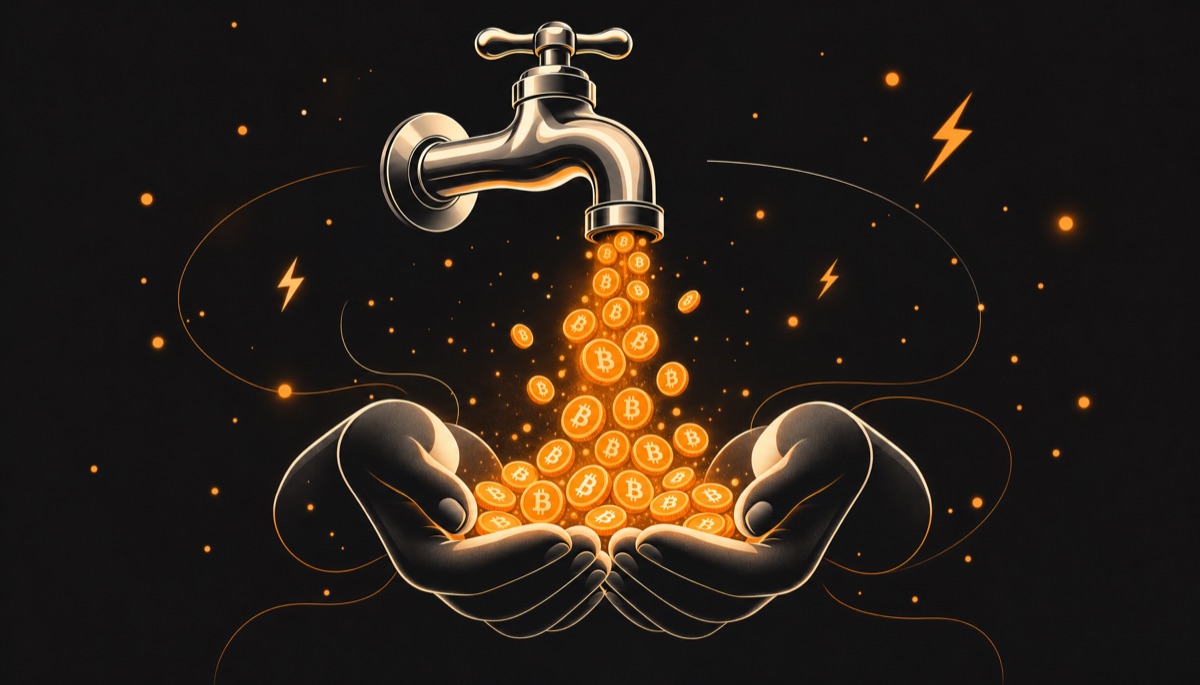
A Bitcoin faucet is a website or app that gives out very small amounts of bitcoin, usually for free, in exchange for a simple action like solving a captcha, viewing a page, completing a task, or playing a game. The amounts are tiny, denominated in satoshis (the smallest unit of bitcoin), but the idea behind a faucet is big: let anyone hold real bitcoin without first having to buy it. This guide explains what Bitcoin faucets are, where they came from, how they work today, why the Lightning Network changed them for the better, and how to use one safely and realistically.
What is a Bitcoin faucet?
A Bitcoin faucet is a service that distributes small quantities of bitcoin to users who complete a low-effort action. The name comes from the image of a dripping tap: each interaction releases a small "drip" of satoshis rather than a meaningful lump sum. A satoshi is one hundred-millionth of a bitcoin, so faucet rewards are commonly measured in single or double-digit satoshi amounts.
The core promise is simple. Instead of asking newcomers to open an exchange account, pass identity checks, and transfer money before they can ever touch bitcoin, a faucet lets them earn a small balance first. That balance is real bitcoin. It can be saved, spent, withdrawn to a personal wallet, or used inside the same platform that handed it out.
Faucets exist for two reasons that reinforce each other. For users, they are a no-risk on-ramp: you can learn how wallets, addresses, and transactions behave using value you did not have to pay for. For operators, they are an acquisition and education tool: a faucet introduces people to a product, a network, or an ecosystem, and some of those people stay, deposit, and become long-term users.
Faucets are not "free money machines"
It helps to set expectations early. A faucet is not a way to get rich, and any service promising large, fast, guaranteed payouts should be treated with suspicion. The honest framing is that a faucet is an educational and engagement tool that happens to pay in real bitcoin. The value of a faucet is the learning, the habit, and the frictionless first experience, not the size of the payout.
A short history of Bitcoin faucets
The first Bitcoin faucet appeared in bitcoin's earliest days, when a single coin was worth a fraction of a cent. The original faucet gave away whole bitcoins to anyone who asked, purely to spread the technology and get coins into circulation. At the time, that was a reasonable way to bootstrap adoption: the coins were nearly worthless, and putting them in people's hands was more valuable than hoarding them.
As bitcoin's price rose, that model became impossible. No operator could keep handing out whole coins, so payouts shrank to thousandths, then millionths, then billionths of a bitcoin. Faucets adapted by paying in satoshis and by adding light requirements such as captchas, timers, and advertisements to cover costs and discourage automated abuse.
For years, the economics were awkward. On-chain Bitcoin transactions carry a network fee paid to miners. When a payout is only a few hundred satoshis but the network fee to send it is larger than the payout itself, paying out directly becomes uneconomical. This is the central problem that shaped the modern faucet, and it is the problem the Lightning Network solved.
How Bitcoin faucets work under the hood
A faucet has three moving parts: a way to verify you are a real person doing a real action, a ledger that tracks what you have earned, and a payout system that eventually gets the bitcoin to you.
Verification
Because rewards are free, faucets must protect against automated farming. Common defenses include captchas, rate limits (you can claim once per interval), required engagement (watching a page, completing a task, or playing a round of a game), and account-level checks. The goal is to make sure each reward goes to a genuine user rather than a script claiming thousands of times per minute.
The internal balance
Most faucets do not send bitcoin to your wallet on every single claim. Instead, they credit an internal balance. Your claims accumulate in an account on the platform, and you withdraw to your own wallet once you decide to. This design exists because of fees: batching many small claims into one larger withdrawal is far more economical than broadcasting a transaction for every drip.
Payout and withdrawal
When you withdraw, the platform sends bitcoin from its internal ledger to an address or invoice you control. On legacy faucets this meant an on-chain transaction with a minimum withdrawal threshold high enough to outweigh network fees. On modern Lightning-based faucets, withdrawal is instant and nearly free, which removes the minimum-threshold pain and makes micro-payouts practical.
The Lightning Network changed everything
The Lightning Network is a payment layer built on top of Bitcoin. Instead of recording every tiny payment on the main blockchain, Lightning lets parties open a payment channel and exchange unlimited fast, cheap payments off-chain, settling to the main chain only when they choose. The result is near-instant transfers with fees so low they are often a fraction of a single satoshi.
For faucets, this is transformational. The original faucet problem (payouts smaller than the fee to send them) simply disappears on Lightning. A platform can credit and pay out a handful of satoshis economically. Withdrawals become instant rather than a once-a-week batch. And because Lightning payments are cheap, a faucet can offer many more ways to earn small amounts without bleeding money on transaction costs.
LNURL-withdraw: how modern withdrawals feel
A common Lightning pattern for paying users is LNURL-withdraw. Rather than asking you to manually create an invoice, the platform shows a QR code or a link. You scan it with a Lightning wallet, and your wallet automatically fetches and pays the withdrawal for you. From your side it feels like tapping a button: scan, confirm, done. This is dramatically simpler than the old flow of copying addresses and pasting them between apps, and it is one reason Lightning faucets feel so much smoother than legacy ones.
What a modern Lightning faucet looks like
A modern faucet is rarely just a claim button on an empty page. To stay sustainable and to give users a reason to return, today's platforms wrap the faucet in a set of earn surfaces, games, and tools. Lightning Faucet is one example of this model: a Bitcoin and Lightning faucet surrounded by games, earning options, prediction markets, and builder tools, all denominated in satoshis.
Free claims and earn surfaces
The faucet itself is the entry point: claim a small amount of sats on a regular interval. Around it sit other earning surfaces such as scratchcards, free spins, and task-based rewards. These give users more than one way to accumulate satoshis and more than one reason to come back. You can explore the earning options on the earn hub, which collects the different ways to pick up sats in one place.
Games denominated in satoshis
Because Lightning makes micro-payments practical, faucet platforms can offer games where bets and wins are measured in satoshis. Lightning Faucet includes classic table and arcade-style games such as roulette, dice, blackjack, baccarat, and slots, plus a scratchcard surface and a free-spin feature. These are entertainment surfaces: they can grow a balance or shrink it, and they should be approached as games, not as income. The point is that everything is sat-denominated and settles over Lightning, so even small stakes work.
Multiplayer poker
Some platforms add multiplayer poker, where real players sit at sat-denominated tables and play hands against each other. Lightning poker fits the faucet model well: buy-ins and pots are measured in satoshis, and the social, skill-based nature of the game gives people a reason to keep playing. You can read more on the poker page.
Prediction markets
A newer addition to the faucet-and-games model is prediction markets, where users stake satoshis on the outcome of real-world events such as weather, network statistics, or sporting results. Prediction markets turn a balance of sats into a way to express a view on the future, and they settle in bitcoin like everything else on the platform. The prediction markets section shows the kinds of markets on offer.
Builder tools
Because Lightning is programmable, some faucet platforms expose developer-facing tools so builders can experiment with paid APIs, machine payments, and Lightning integrations. This rounds out the ecosystem: the same platform that hands a newcomer their first satoshis can give a developer a sandbox for building Lightning-native products.
Are Bitcoin faucets worth it?
Whether a faucet is "worth it" depends entirely on what you want from it.
If your goal is to learn how Bitcoin and Lightning work, a faucet is genuinely valuable. You get a real balance, a real wallet, and real transactions without spending money. You will understand satoshis, addresses, invoices, QR codes, and withdrawals far better after using a faucet for a week than after reading about them for a month.
If your goal is to earn meaningful income, a faucet is not the right tool. Payouts are small by design. The realistic outcome of disciplined faucet use is a slowly growing balance of satoshis, not a paycheck. Anyone telling you otherwise is selling something.
If your goal is entertainment with real stakes, the games-and-faucet model can be appealing, as long as you treat the games as games. The faucet and earn surfaces let you accumulate a balance for free, and the games let you spend that balance on entertainment. Keeping those two ideas separate, free earning versus paid entertainment, is the key to a healthy experience.
How to use a Bitcoin faucet safely
A few habits keep the experience positive and protect you from the genuinely sketchy corners of this space.
- Verify the payout is real. A legitimate faucet lets you withdraw to your own wallet. If withdrawals are impossible, perpetually delayed, or require a deposit first, walk away.
- Use a wallet you control. Withdraw your satoshis to a Lightning wallet where you hold the keys or at least control the account. Treat the platform balance as a place to accumulate, not a place to store long term.
- Watch the requirements. Be wary of faucets that demand excessive personal information, force endless ad views, or push aggressive referral schemes. A reasonable faucet asks for a captcha or a simple action, not your life story.
- Understand the games. If a platform wraps its faucet in games, read how they work before you play with anything beyond your free balance. Games can lose your sats as easily as win them.
- Mind the fees on withdrawal. On a Lightning faucet, withdrawals are cheap and fast. On a legacy on-chain faucet, expect minimum withdrawal thresholds and network fees that eat into small balances.
Why faucets still matter
It would be easy to dismiss faucets as a relic of bitcoin's penny-priced past. They are not. They remain one of the most effective on-ramps in the entire ecosystem because they remove the single biggest barrier to entry: the requirement to spend money before you can participate. A person who has never owned bitcoin can, in minutes, hold a small amount, send it, receive it, and watch a Lightning payment settle. That first-hand experience is worth more than any explainer.
The Lightning Network gave faucets a second life. By making micro-payments instant and nearly free, it turned the faucet from an awkward, fee-bound novelty into a smooth, sustainable surface that can sit at the center of a real product. The modern faucet is an entry point to a whole ecosystem of sat-denominated games, earning options, prediction markets, and builder tools, all settling over Lightning. If you have never used one, it is the cheapest, lowest-risk way to start understanding how bitcoin actually moves.
Frequently asked questions
What is a Bitcoin faucet in simple terms?
A Bitcoin faucet is a website or app that gives out tiny amounts of bitcoin, measured in satoshis, in exchange for a simple action like solving a captcha or playing a game. It is designed as a free, no-risk way to start holding real bitcoin without buying it first.
How much can you really earn from a Bitcoin faucet?
Very little, by design. Faucet payouts are small, often a few satoshis at a time, so the realistic result of regular use is a slowly growing balance rather than meaningful income. The real value is the learning experience and the frictionless first taste of holding and moving bitcoin, not the payout size.
Why do faucets use the Lightning Network?
On-chain Bitcoin transactions carry a network fee, and for tiny payouts that fee can be larger than the payout itself. The Lightning Network makes payments instant and nearly free, so a faucet can credit and pay out a handful of satoshis economically. Lightning also enables instant withdrawals, often through LNURL-withdraw, where you scan a QR code and your wallet fetches the payment automatically.
Are Bitcoin faucets safe to use?
Reputable faucets are safe, but the space has bad actors. Stick to faucets that let you withdraw to your own wallet, avoid any service that requires a deposit before you can claim or withdraw, and be cautious of platforms demanding excessive personal information. Withdraw your satoshis to a wallet you control rather than leaving large balances on the platform.
Do I need to buy bitcoin to use a faucet?
No. The whole point of a faucet is that you start with free satoshis. You claim small amounts for completing simple actions and accumulate a balance, then withdraw it to your own Lightning wallet. You never have to spend money to get your first bitcoin through a faucet.
What is the difference between a faucet and the games around it?
The faucet and earn surfaces give you satoshis for free, while the games let you stake that balance for entertainment. They are separate ideas: the faucet is a no-risk way to accumulate sats, and games like roulette, dice, blackjack, or multiplayer poker are entertainment that can grow or shrink your balance. Keeping free earning and paid play mentally separate is the key to using a modern faucet platform well.
By the Lightning Faucet team