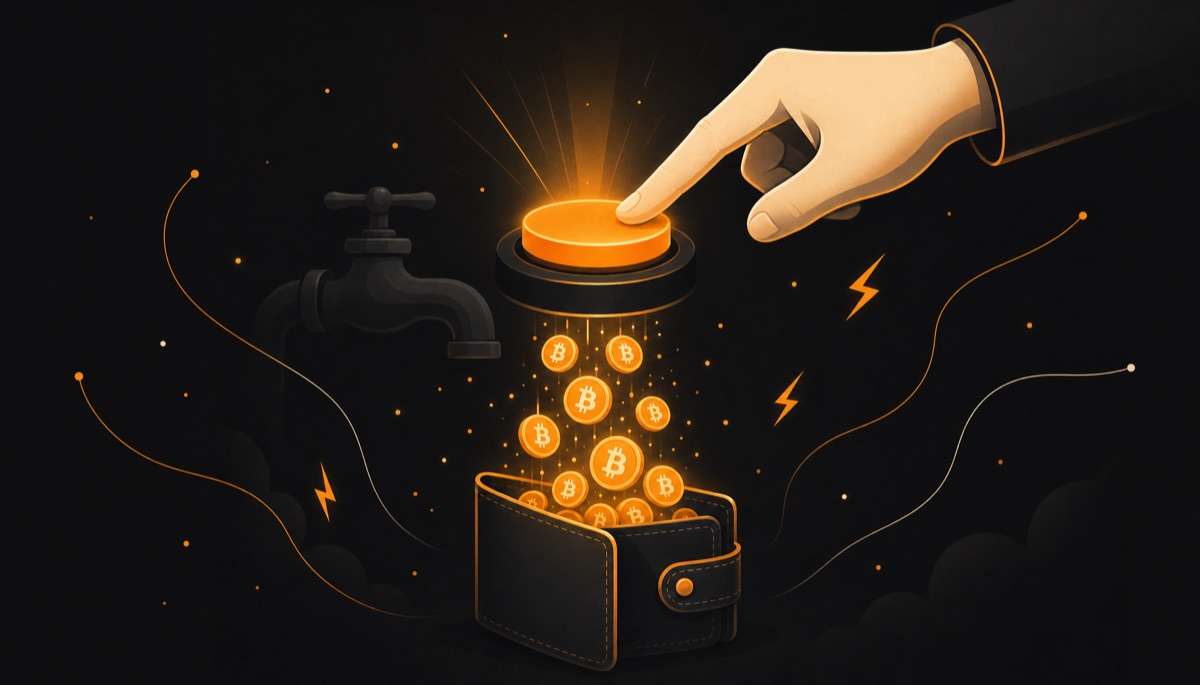
A Bitcoin faucet is one of the simplest ways to get your first satoshis without buying them on an exchange. You visit a site, complete a small action, and a tiny amount of Bitcoin lands in your balance. But "claiming sats" trips up a lot of newcomers: they aren't sure what a satoshi is, how the claim actually pays out, or how to move those coins into a wallet they control. This guide walks through the whole process end to end, so you can claim your first sats with confidence and understand exactly what is happening under the hood.
What Is a Satoshi (and Why Faucets Pay in Sats)
A satoshi, or sat, is the smallest unit of Bitcoin. One Bitcoin is divisible into 100,000,000 satoshis, so a single sat is 0.00000001 BTC. Because a whole Bitcoin is worth far too much to hand out for free, faucets deal exclusively in sats. When a faucet advertises a "reward of 50 sats," it is giving you 0.0000005 BTC, a fraction of a cent by fiat value but a real, spendable amount of Bitcoin.
Paying in sats is what makes faucets possible. If faucets tried to distribute whole coins or even fractions written in BTC, the numbers would be unwieldy and the payouts would be prohibitively expensive. Sats let a faucet reward thousands of users with meaningful, countable amounts. It also trains your eye to think in the native unit of Bitcoin, which is how most people in the space actually talk about small balances.
What "claiming" means
Claiming is the act of triggering a faucet payout. You complete whatever the faucet asks, a timer or a task, and in return the faucet credits sats to your account balance. On modern faucets, claiming does not immediately push coins onto the blockchain. Instead, the sats accumulate in your on-site balance, and you withdraw them to your own wallet when you are ready. This two-step model, claim then withdraw, keeps fees low and makes small rewards practical.
Why Bitcoin Faucets Exist
Faucets were invented to solve a chicken-and-egg problem: people could not use Bitcoin until they owned some, but they were reluctant to buy any until they understood how it worked. A faucet breaks that loop. It gives you a small amount of real Bitcoin to experiment with, so you can learn to receive, hold, and send sats without risking your own money first.
For the sites that run them, faucets are a low-friction way to introduce people to a broader product. A well-run faucet is rarely just a faucet. It is usually the front door to a suite of ways to earn and use Bitcoin: games, reward surfaces, prediction markets, and builder tools. The free claim gets you in; the surrounding features give you reasons to stay and keep stacking sats.
The Role of the Lightning Network
Older faucets paid out directly on the Bitcoin base layer (called on-chain). That worked, but it had two big problems for tiny amounts: on-chain transactions carry a network fee, and when the fee is larger than the payout itself, the reward becomes pointless. Base-layer transactions can also take time to confirm.
The Lightning Network fixed this. Lightning is a second layer built on top of Bitcoin that settles payments almost instantly and with negligible fees. It was designed for exactly the kind of small, frequent payments that faucets create. When you withdraw sats from a Lightning-enabled faucet, the coins move over Lightning, arriving in your wallet in seconds for a fraction of a fraction of a cent.
This is why the withdrawal step matters so much. You will need a Lightning wallet to receive your claimed sats efficiently. We will cover how that works below.
Step by Step: How to Claim Sats From a Bitcoin Faucet
Here is the general flow. The exact button labels differ from site to site, but the sequence is almost always the same.
1. Create an account or sign in
Most faucets ask you to register so they can track your balance and reward history. Registration is usually just an email and password, and many faucets also support Lightning login (sometimes called LNURL-auth), where you sign in by scanning a QR code with your Lightning wallet instead of typing a password. Lightning login is fast, private, and means there is no password to lose, so use it if it is offered.
2. Find the claim or free-spin surface
Once you are signed in, look for the faucet claim itself. It might be labeled "Claim," "Faucet," "Free Spin," or something similar. On Lightning Faucet, the recurring free reward lives on the free-spin page, where you can take a spin on a set schedule and collect whatever it lands on.
3. Complete the required action
Faucets ask for a small action before they pay. The most common is simply waiting out a cooldown timer, then clicking claim. Others attach the reward to a light task: solving a captcha to prove you are human, spinning a wheel, or completing a short offer. The action is intentionally low effort. Its purpose is to prevent automated abuse and to space out claims, not to make you work.
4. Watch the sats hit your balance
After you complete the action, the reward is credited to your on-site balance. You will typically see your sat total tick up immediately. At this point the sats are yours, held in your faucet account, but they are not yet in a wallet you control on your own device.
5. Repeat on the schedule
Faucets are designed for repeat visits. Most claims are gated by a cooldown, so you can come back every few minutes or hours and claim again. The individual amounts are small by design, so stacking sats from a faucet is a patience game. The value is in learning the mechanics and building a balance over time, not in getting rich from a single claim.
6. Withdraw to your own wallet
When your balance reaches the site's minimum withdrawal threshold, you can move your sats off the platform and into a wallet you control. This is the most important step for actually owning your Bitcoin, and it deserves its own section.
How to Withdraw Your Claimed Sats
Claiming builds a balance on the faucet. Withdrawing is how you take custody of it. The gold standard on Lightning-enabled faucets is LNURL-withdraw, which makes the process almost effortless.
Here is how a typical Lightning withdrawal works:
- Open your Lightning wallet. You need a wallet that supports Lightning. Popular options are easy to install on a phone in minutes.
- Start the withdrawal on the faucet. Choose "Withdraw," enter the amount (or accept your full balance), and the site shows you a QR code or a tappable link.
- Scan or tap. Your wallet reads the LNURL-withdraw code and automatically fetches the payment request. You do not need to generate an invoice yourself; the wallet handles it.
- Confirm. Approve the incoming payment in your wallet, and the sats arrive, usually within seconds.
That is the whole withdrawal. Because Lightning fees are tiny, almost all of your claimed sats survive the trip. If a withdrawal ever fails to route, well-built platforms automatically refund the amount back to your balance within a minute or two, so your sats are never lost, just returned for you to try again.
Choosing a Lightning wallet
Any reputable Lightning wallet will do. The main decision is whether you want a custodial wallet (the provider holds the keys, simplest to start) or a non-custodial wallet (you hold the keys, more responsibility, more control). For your first faucet withdrawal, a custodial wallet is a perfectly reasonable on-ramp. As your stack grows and you get comfortable, moving to a non-custodial setup gives you full self-custody of your Bitcoin.
Going Beyond the Faucet: Other Ways to Stack Sats
The free claim is the beginning, not the end. A single faucet spin pays little on purpose. The faster ways to grow a sat balance are usually the surrounding features. On a full-featured platform like Lightning Faucet, the same account that holds your faucet claims can be used across several sat-denominated surfaces.
Earn surfaces
Beyond the timed claim, many platforms offer earn activities: reward tasks, scratchcards, offers, and missions that pay out in sats for completing something. These typically pay more than a bare faucet click because they ask a little more of you. You can browse what is available on the earn hub, which collects the reward surfaces in one place. If you like the instant-result format of the faucet, the scratchcard is a natural next stop.
Games
If you want to put a few claimed sats into play, casino-style games settle in sats too. Classic tables like roulette, dice, blackjack, and baccarat are all denominated in satoshis, so you are wagering and winning in the same unit your faucet pays out. Games carry risk in a way that claiming does not, so treat them as entertainment and only stake sats you are comfortable playing with.
Multiplayer poker
Lightning poker lets you sit at sat-denominated tables and play real multiplayer poker against other players, with buy-ins and pots counted in satoshis. It is a way to use your Bitcoin in a skill game rather than a pure chance game, and it settles over Lightning like everything else.
Prediction markets
Prediction markets let you stake sats on the outcome of future events, from Bitcoin network metrics to sports and weather. If you have a view on how something will resolve, you can back it with sats and collect if you are right. It is a different flavor of using Bitcoin than either games or the faucet, and it rounds out the set of ways to put your claimed sats to work.
Builder tools
Finally, if you are a developer, faucet sats are the perfect testing capital. Platforms with builder surfaces expose APIs and paid-endpoint tooling so you can wire Lightning payments into your own apps. Claiming a handful of sats gives you real money to test flows without touching an exchange.
Tips for Getting the Most Out of a Bitcoin Faucet
- Use Lightning login if offered. It is faster and there is no password to manage or lose.
- Withdraw to a wallet you control. Sats sitting in a site balance are convenient, but self-custody is the point of Bitcoin. Learn the LNURL-withdraw flow early.
- Be realistic about amounts. Faucet claims are small. Their value is educational and cumulative, not a fast payday. Anyone promising huge free payouts is a red flag.
- Explore the earn surfaces. The faucet is the on-ramp; scratchcards, missions, and other reward surfaces usually stack sats faster.
- Keep claiming on schedule. Cooldowns reset. Regular small claims add up over time.
- Protect your account. Use a strong, unique password if you register with email, and be wary of any site or message asking for your wallet's seed phrase. A legitimate faucet never needs it.
Common Mistakes to Avoid
New claimers tend to hit the same few snags. The first is not withdrawing, leaving a growing balance parked on a site indefinitely; move sats to your own wallet once you cross the minimum. The second is trying to generate an invoice manually for a Lightning withdrawal; with LNURL-withdraw you simply scan or tap and the wallet does the rest. The third is chasing unrealistic payouts; a faucet that promises far more than the norm is usually trying to harvest your attention, your data, or worse. Stick to platforms that are honest about how small individual claims are and that give you real ways to stack more.
Frequently Asked Questions
How many sats can I claim from a Bitcoin faucet?
It varies by faucet and by claim. Individual faucet rewards are intentionally small, often a handful of sats per claim, because they are gated by a cooldown and repeat over time. The real total depends on how regularly you claim and whether you also use the platform's earn surfaces, which typically pay more than a bare faucet click.
Do I need to buy Bitcoin before I can use a faucet?
No, and that is the entire point of a faucet. It gives you a small amount of real Bitcoin for free so you can learn to receive, hold, and send sats without spending any of your own money. Once you are comfortable, you can decide whether to buy more.
What wallet do I need to withdraw my sats?
You need a Lightning wallet, since most modern faucets pay out over the Lightning Network for near-instant, low-fee transfers. Any reputable Lightning wallet works. Custodial wallets are the simplest place to start; non-custodial wallets give you full control of your keys as you get more comfortable.
Why do I have to wait between claims?
The cooldown timer serves two purposes. It spaces out payouts so the faucet can reward many people sustainably, and it discourages automated abuse. Waiting out the timer and claiming again is the normal rhythm of using a faucet, and the small amounts add up as you repeat.
Is claiming sats from a faucet safe?
Claiming itself is safe as long as you use a reputable platform. The main things to watch for are sites that ask for your wallet's seed phrase (never share it; no legitimate faucet needs it) and offers that promise unrealistically large free payouts. Withdrawing your sats to a wallet you control is the safest way to take real ownership of what you claim.
What can I actually do with the sats I claim?
Quite a lot. You can withdraw them to your own Lightning wallet and hold them, spend them anywhere Lightning is accepted, put them into sat-denominated games and multiplayer poker, stake them on prediction markets, or use them as test capital if you are a developer. The faucet is just the starting point for getting Bitcoin into your hands.
Wrapping Up
Claiming sats from a Bitcoin faucet is genuinely simple once you understand the two-step model: you claim to build a balance, then you withdraw over Lightning to take custody. Start by creating an account (Lightning login if you can), complete the faucet's small action, watch your sats accumulate, and move them into a wallet you control when you hit the minimum. From there, the same balance can flow into earn surfaces, games, poker, prediction markets, and builder tools, all denominated in the same satoshis you just claimed for free. Get the claim-and-withdraw loop down once, and you have the core skill for everything else in the Lightning economy.
By the Lightning Faucet team