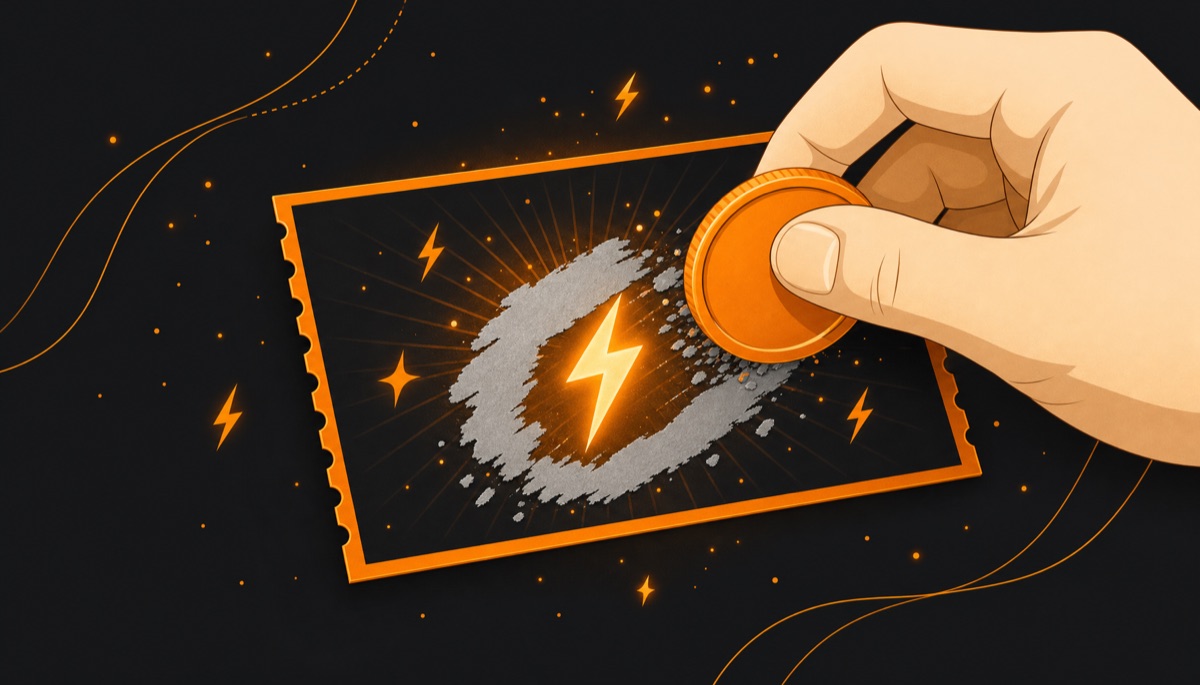
A Bitcoin scratchcard is a digital version of the classic paper scratch ticket, redesigned so that every prize is paid in satoshis and settled instantly over the Lightning Network. You reveal a hidden grid of symbols, match the ones the rules call for, and any win lands in your Bitcoin balance within seconds. There is no coin to scrape, no printed ticket to mail in, and no waiting days for a payout to clear. The whole loop, reveal, match, and get paid, happens in your browser.
This guide explains what a Bitcoin scratchcard actually is, how the reveal mechanic works under the hood, why "free" and "provably fair" are not contradictions, and how to think about odds and payouts so you play with clear expectations. By the end you will understand the format well enough to try one without guessing.
What is a Bitcoin scratchcard?
At its simplest, a Bitcoin scratchcard is a small, single-play game with a hidden outcome and an instant, sat-denominated payout. Think of it as the shortest possible game loop in Bitcoin gaming: one card, one reveal, one result.
Traditional lottery scratchcards work by hiding a printed result under a layer of latex. You scratch the coating away, compare the revealed symbols to a legend, and if they match, you take the ticket to a retailer to redeem. A Bitcoin scratchcard keeps the reveal-and-match experience but replaces every slow, physical, trust-dependent step with something digital and near-instant:
- The hidden coating becomes a set of panels you tap or drag to uncover.
- The printed result becomes a value committed before you play, so it cannot be changed mid-game.
- The retailer redemption becomes an automatic Lightning credit to your balance.
Because the payout rail is Lightning, wins are denominated in satoshis (sats), the smallest unit of Bitcoin. One bitcoin is 100,000,000 sats, so scratchcard prizes are naturally small, frequent, and easy to pay out without the fees that would make tiny payouts impossible on the base Bitcoin chain.
Where the "free" part comes from
The word "free" in "free Bitcoin scratchcard" usually means the card costs you nothing to play. On a faucet-style platform, you earn or claim scratch attempts rather than buying them with a deposit. A faucet is a service that hands out small amounts of Bitcoin, historically to introduce people to the technology, and a free scratchcard is one of the more engaging ways to distribute those small amounts. Instead of a flat drip, you get a game with a little suspense and a chance at a larger-than-average reveal.
That is the core idea: the platform funds the prize pool, you contribute attention and a reveal, and the winnings are real sats you can eventually withdraw. You can try the format on the Lightning Faucet scratchcard page, which is built around exactly this earn-and-reveal loop.
How a Bitcoin scratchcard works, step by step
Here is the full lifecycle of a single card, from load to payout.
1. The outcome is committed before you scratch
This is the most important and least visible step. Before you touch a single panel, the game has already decided the card's result. On a well-built platform, that result is locked in cryptographically, using a commit-and-reveal scheme, so the outcome cannot shift based on how you scratch or which panels you open first.
This matters because it removes the two things people rightly worry about: an operator changing the result once they see you are winning, and the illusion that clever scratching order can improve your odds. The card is what it is the moment it is generated. Your scratching only reveals what is already there.
2. You reveal the panels
The interface presents a grid of covered symbols, prizes, or numbers. You uncover them by tapping, clicking, or dragging across the coating. The animation is cosmetic; the fun is in the reveal, not in the mechanics of removing the layer.
Most Bitcoin scratchcards use one of a few classic win conditions:
- Match-three: uncover three identical symbols anywhere on the card to win the amount those symbols represent.
- Match a target: reveal a "winning number" and then find it among your scratched numbers.
- Symbol collection: gather a specific combination, such as three of the same prize tier, to claim it.
3. The result is evaluated
Once you have revealed enough of the card to determine the outcome, the game compares your grid to the win conditions. Because the result was fixed in step one, this evaluation is deterministic: there is exactly one correct answer, and both you and the platform can confirm it.
4. Winnings settle over Lightning
If the card is a winner, the prize is credited to your balance in sats, typically within a second or two. There is no separate claim step, no email confirmation, and no manual review for ordinary wins. Lightning's job here is to make tiny payouts economical and instant, which is precisely what a high-frequency, low-stakes game like a scratchcard needs.
5. You play again or bank your sats
Because each card is self-contained, you can play the next one immediately or let your balance accumulate. When you are ready to move funds off the platform, you withdraw over Lightning to your own wallet.
Provably fair: why you don't have to trust the operator
"Provably fair" is a phrase you will see attached to good Bitcoin games, and it is worth understanding rather than glossing over.
The idea rests on a commit-and-reveal design. Before the round, the server generates the outcome and publishes a cryptographic fingerprint of it, a hash, which is like a sealed envelope. The hash proves the result exists and is fixed, but it does not reveal what the result is. After the round, the server reveals the original value, and you can hash it yourself and confirm it matches the fingerprint you were shown earlier. Frequently a value you provide, a client seed, is mixed in too, so the operator cannot have pre-computed a losing card specifically for you.
The practical upshot: you do not have to trust that the operator was honest. You can verify it. That is a meaningful upgrade over a paper scratchcard, where you simply have to believe the printing was fair and the odds on the back of the ticket are accurate.
If provable fairness is the feature that drew you in, it is worth knowing it underpins more than scratchcards. The same commit-and-reveal thinking runs through the wider Lightning Faucet casino, including dice and roulette, where a verifiable result is the whole point.
Odds, payouts, and realistic expectations
A scratchcard is designed around a prize distribution: many small wins, fewer medium wins, and rare large ones, with a good number of cards paying nothing. This shape is deliberate. Frequent small wins keep the game engaging, while the rare top prize provides the upside.
A few honest points to set expectations:
- Most cards are low-value or non-winning. That is normal for the format and true of paper scratchcards too. The excitement comes from the occasional above-average reveal.
- Free cards fund modest prizes. When a card costs you nothing, the prize pool is funded by the platform, so top prizes are sized accordingly. Think "a nice little bonus," not "life-changing jackpot."
- Odds are fixed per card, not per session. Because each card's outcome is committed independently, playing more cards does not make any single card more likely to win. Each is a fresh, independent draw.
- Volatility is a feature. A game with only tiny, guaranteed payouts would be boring; a game with only huge, rare payouts would feel like it never pays. Scratchcards sit in between by design.
Understanding this keeps the experience fun. A scratchcard is a light, fast game with a real chance of a small sat win, not a wealth strategy.
How scratchcards fit into a wider Bitcoin gaming platform
Scratchcards are one of the friendliest on-ramps to Bitcoin gaming because they require no strategy and resolve instantly. But they are usually a doorway into a broader set of ways to earn and play with sats.
On a platform like Lightning Faucet, a free scratchcard sits alongside earn surfaces, casino games, prediction markets, and even builder tools. Once you are comfortable with instant Lightning payouts from a scratchcard, the same rails power everything else:
- Instant-resolve casino games such as dice, blackjack, and roulette, each with its own risk profile.
- Sat-denominated multiplayer poker, where you play real hands against real players for satoshi stakes on the Lightning poker tables.
- Prediction markets, where you take positions on real-world outcomes and settle in sats. If forecasting appeals to you more than pure chance, the prediction markets reward being right rather than being lucky.
- Earn surfaces that let you accumulate sats through tasks and activities, which you can then spend across the games.
The common thread is Lightning: whatever you play, wins and losses settle in sats, fast and cheap, without the platform holding your funds hostage behind slow withdrawals.
Tips for getting the most out of free Bitcoin scratchcards
You cannot influence a committed outcome, so "strategy" here is really about good habits:
- Play free cards whenever they are available. If the platform hands out scratch attempts, use them. Free upside is free upside.
- Withdraw to your own wallet periodically. Self-custody is the point of Bitcoin. Move accumulated sats to a Lightning wallet you control.
- Verify fairness once, so you trust it always. If the platform is provably fair, check the proof a single time to satisfy yourself the mechanism works. After that you can just enjoy the game.
- Treat wins as a bonus, not income. The healthiest way to enjoy scratchcards is as a light, fun reveal with a real chance of a small payout.
Conclusion
A Bitcoin scratchcard takes a format everyone already understands, scratch and match, and rebuilds it on rails that make it instant, verifiable, and payable in the smallest unit of Bitcoin. The outcome is committed before you play, the reveal is just theatre for a result already set, and any win settles over Lightning in seconds. "Free" means the platform funds your attempts; "provably fair" means you never have to take the operator's word for it.
If you want to feel the loop for yourself, a single card is the fastest way to understand it. Reveal one, watch the sats land, and you will know exactly how the format works.
By the Lightning Faucet team.