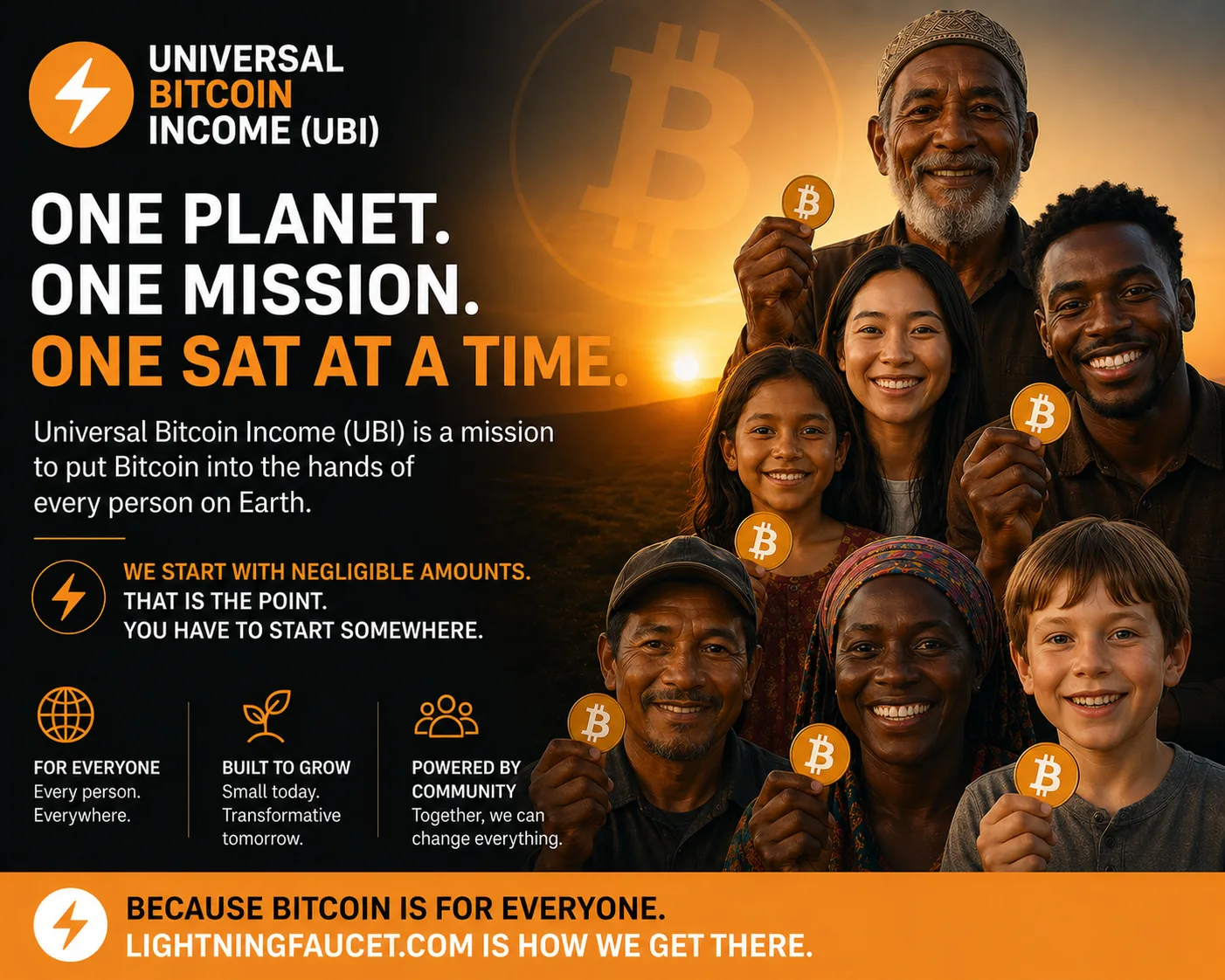
Universal Bitcoin Income is a mission to put Bitcoin into the hands of every person on Earth. The amounts we start with are negligible. That is the point. You have to start somewhere.
To understand why this matters, you need to understand how Bitcoin divides.
The Denomination Hierarchy
One bitcoin is the whole unit. At current prices, a single bitcoin is worth tens of thousands of dollars. Most people will never own a whole one, and they do not need to.
One satoshi is one hundred-millionth of a bitcoin. Written as a fraction: 1/100,000,000. The satoshi is Bitcoin's native subunit, the smallest amount recognized by the base protocol. At today's prices, a single satoshi is worth a fraction of a fraction of a cent.
One microsat is one-thousandth of a satoshi. Written as a fraction: 1/100,000,000,000 of a bitcoin. Microsats exist at the Lightning Network layer, where payment channels can track balances below the on-chain satoshi floor. They are not a theoretical concept. They are real, transferable units of value.
This is the denomination hierarchy: bitcoin, satoshi, microsat. Each step down divides by a large factor. Each step down makes Bitcoin accessible to more people.
Why Start This Small?
The honest answer: because we have to start somewhere, and pretending to start bigger would be dishonest.
Universal Bitcoin Income is not a promise of wealth. It is a commitment to distribution. The goal is to get Bitcoin, in any amount, into the hands of anyone who wants it. Microsats let us do that at a scale that would be impossible with larger denominations.
Consider the math. If you want to distribute Bitcoin to a million people, you need a million times whatever you give each person. At the satoshi level, giving one sat to a million people costs 0.01 BTC. At the microsat level, giving one thousand microsats (equal to one satoshi) to a million people costs the same, but you can reach ten times more people at one hundred microsats each.
Microsats are the unit that makes universal distribution feasible.
The Precedent
In 2010, the first Bitcoin faucet gave away 5 BTC to anyone who visited. Five whole bitcoins, worth fractions of a penny at the time. The creator, Gavin Andresen, wanted people to experience Bitcoin firsthand. To hold it, send it, and see that it worked.
Those 5 BTC are now worth a fortune. The people who received them did not just get a technical demonstration. They got a stake in the future of money.
No one knew that in 2010. The amounts seemed trivial. The technology seemed obscure. But someone decided to start distributing anyway.
That is what we are doing with microsats. The amounts are trivial today. We acknowledge that openly. But the principle, that every person deserves access to sound money, does not require large amounts to begin.
The Economic Case
The world is changing. AI is transforming labor markets. Energy costs are trending toward zero. The question of how value gets distributed in this new economy is wide open.
Traditional Universal Basic Income proposals require government taxation and centralized distribution. They are politically contentious, geographically limited, and subject to the same inflationary pressures that erode purchasing power.
Bitcoin-based UBI is different. It is funded by the community, not by taxation. It is distributed by the Lightning Network, not by bureaucracies. It is available to anyone on Earth with an internet connection. And because Bitcoin is deflationary by design, the purchasing power of these distributions can grow over time rather than shrink.
This is the asymmetry that makes starting small worthwhile. In an inflationary system, tiny amounts become less valuable over time. In a deflationary system, tiny amounts can become more valuable. The microsats distributed today carry nonzero optionality.
Micro Transactions and Micro Deposits
The Lightning Network makes it possible to send and receive amounts that would be absurd on any other payment rail. Credit cards have minimum transaction amounts. Bank wires have fees that dwarf small transfers. Even most cryptocurrency networks have transaction costs that make sub-cent payments impractical.
Lightning settles in milliseconds, with fees measured in fractions of a satoshi. This is the infrastructure that makes microsat-level distribution possible. It is also the infrastructure that could eventually enable microsat-level commerce: machines paying machines, sensors paying for data, agents paying for compute, all in amounts too small for any other system to handle.
Universal Bitcoin Income is not just about giving people money. It is about building the habit of micro transactions. Receiving microsats. Sending microsats. Watching a balance grow one tiny increment at a time. Understanding, through direct experience, that Bitcoin works at every scale.
The Vision
Today, the amounts are negligible. We will say that as many times as necessary because we believe honesty about the starting point is more important than inflated promises.
But the mission is not negligible. Every person who receives their first microsats is one more person who holds Bitcoin. One more person with a Lightning wallet. One more person who understands, from direct experience rather than headlines, what sound money feels like in practice.
The fund grows through community donations. Every satoshi donated goes directly to distributions. As Bitcoin appreciates and participation grows, the distributions grow with it.
We are not promising anyone a fortune. We are promising a starting point. The first Bitcoin faucet proved that starting points matter. We intend to prove it again.
Learn more at lightningfaucet.com/ubi.